


Ligue para nós
Goiânia-GO: (62) 3602-1328 / (62) 99977-4401
*atendemos todo o Brasil
Goiânia-GO: (62) 3602-1328 / (62) 99977-4401
*atendemos todo o Brasil
você está em -> RF Ambiental - Tratamento de água, efluentes, reuso agua, seja ele industrial, comercial ou residencial > Sem categoria > When Simulation Matters: How Rabby’s Pre-Transaction Engine Changes the Risk Calculus for DeFi Power Users
Imagine you are about to execute a multi-step DeFi trade on Arbitrum: a swap, an approval, and a liquidity deposit. The dApp prompts your wallet to sign a transaction. You glance at a raw hex payload, hope the gas estimate is reasonable, and hit confirm. Few things in DeFi frustrate experienced users more than “blind signing” — confirming transactions whose effects you do not actually understand until they land on-chain. That scenario is why transaction simulation is not a cosmetic feature; for serious users it is a risk management tool that alters how you interact with protocols and composes strategy across chains.
This article takes the mechanism-first view: what transaction simulation does, how Rabby implements it in a browser extension context, where the approach materially reduces risk, and where it still leaves gaps. The goal is not to market a product but to give power users a reusable mental model for choosing and configuring a multi-chain wallet that claims to simulate transactions and block suspicious operations.
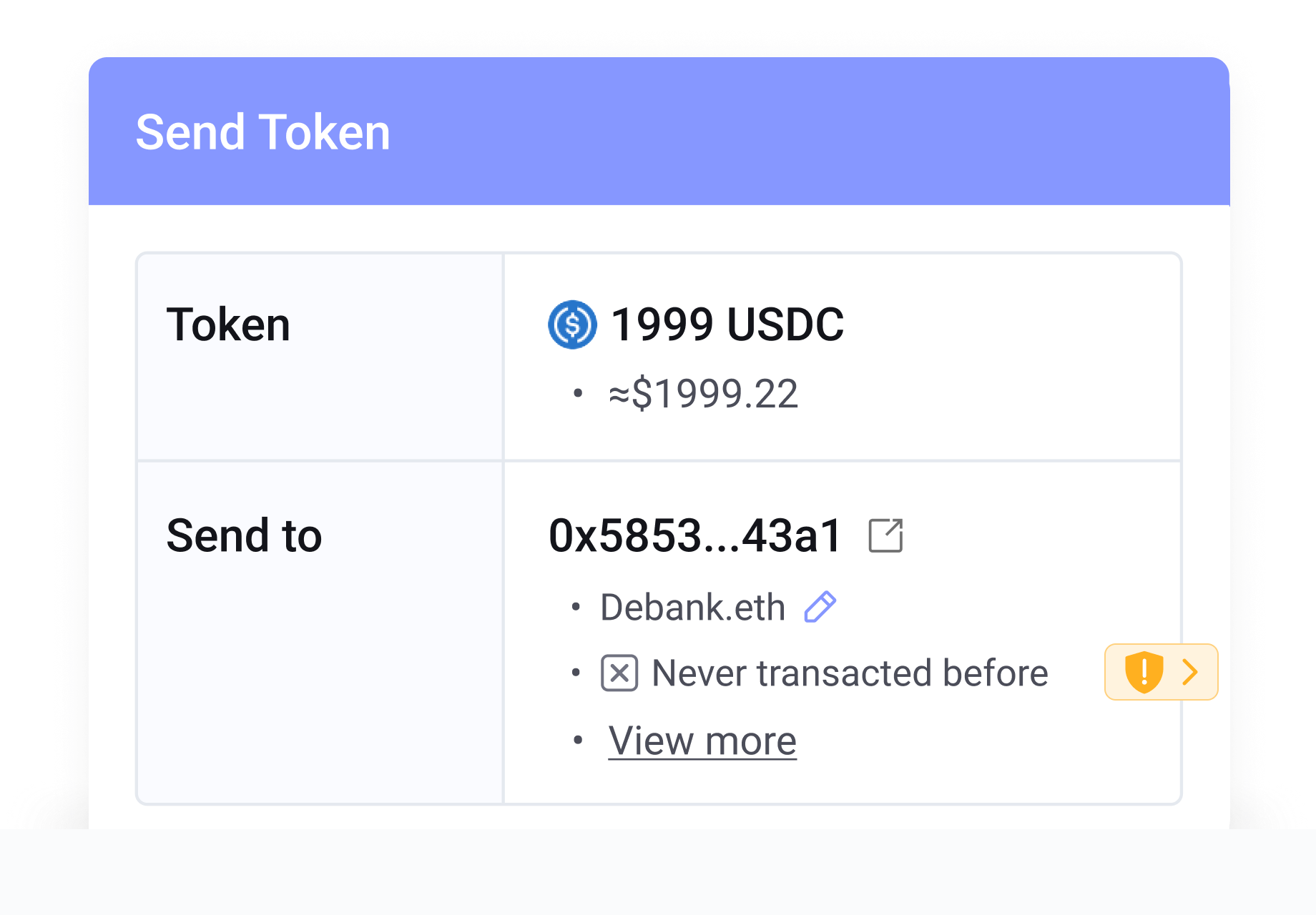
At its simplest, a transaction simulator takes the signed or unsigned transaction intent, runs it against a local or remote node state (or a forked state), and computes post-execution balances, events, and contract state changes. For a browser extension this typically means: construct the exact call data the dApp is requesting, replay that call in a safe environment, and present the user with human-readable outputs — token deltas, NFT transfers, contract approvals, and precise fee estimates.
Rabby’s simulation feature is designed to prevent blind signing by showing estimated token balance changes and expected gas costs before the user submits the signature. Coupled with a pre-transaction risk scanner that flags hacked contracts, suspicious approvals, or non-existent recipients, the simulator converts opaque bytecode into actionable facts. Mechanistically, this requires accurate state snapshots for each supported EVM chain and a deterministic execution environment. The wallet must also map contract addresses to recognizable labels and known-risk lists to make the simulation readable.
For heavy DeFi users — portfolio managers, arbitrageurs, liquidity providers — two features matter beyond basic custody: (1) precise awareness of net token flows, and (2) the ability to revoke unnecessary approvals quickly. When you interact across 90+ EVM chains as Rabby supports, small mistakes compound: approving an exploitable contract on a low-liquidity chain can mean a full drain, and the same approval pattern repeated across chains multiplies exposure.
Transaction simulation reduces uncertainty in three practical ways. First, it converts transaction payloads into a clear “before/after” balance table, so you can spot unexpected token transfers. Second, it surfaces gas costs in native units for the active chain and can inform whether a cross-chain gas top-up is necessary. Third, when combined with an approval revocation tool, it shortens the distance between detecting a bad approval and mitigating exposure.
These mechanics make a concrete difference in the U.S. context where regulatory pressures and fiat on/off ramps are fragmented: without a built-in fiat on-ramp in the wallet, users often route funds through exchanges and bridge services — interactions that are error-prone. A simulation-friendly wallet helps catch mistakes before they propagate through these cross-service paths.
Simulation reduces but does not eliminate risk. It depends on an accurate execution environment; if the on-chain state used for the simulation lags or a contract uses block-dependent randomness or oracle-fed external data, the simulated result may diverge from on-chain reality. Moreover, simulations can miss front-running or MEV (miner/executor adversarial reorderings) that change executed outcomes between simulation and inclusion in a block.
Rabby’s model also faces practical boundary conditions: the wallet flags suspicious contracts using curated lists and heuristics, but these lists can be incomplete or lag new attacks. The product’s open-source MIT-licensed codebase helps independent audits, but past incidents (notably a 2022 Rabby Swap contract exploit) illustrate that even teams with active security programs can be vulnerable. The useful takeaway is this: simulation is an additional layer — influential, but not omnipotent. Combine it with hardware-wallet signing, multi-sig where appropriate, and conservative approval practices.
Another trade-off is UX friction. Showing detailed simulations for every signature can interrupt fast workflows like routine gasless approvals or signed permits; power users must balance safety against cognitive overhead. Rabby mitigates this somewhat through automatic network switching and a Flip toggle to swap behavior with other wallets, but those choices highlight a wider design tension between speed and scrutiny.
In the EVM wallet ecosystem, prominent alternatives include MetaMask, Trust Wallet, and Coinbase Wallet. What distinguishes a simulator-centric wallet is not novelty but integration: a simulator that’s tightly coupled with pre-transaction risk scanning, approval revocation, cross-chain gas top-up, and hardware-wallet support materially changes operational risk-management. Rabby combines those elements — and integrates with institutional tools like Gnosis Safe and Fireblocks — which makes it pragmatically appealing for users bridging retail and institutional practices.
That said, the lack of a native fiat on-ramp and in-wallet staking means Rabby is optimized for users who already have on-chain capital and who prioritize operational control over convenience. For some U.S.-based traders who prefer a single app to buy, stake, and manage taxes, the missing fiat entry point is a practical limitation. For others who value fine-grained control, the wallet’s open-source posture and hardware compatibility are decisive advantages.
Use the following rules of thumb when a simulated transaction appears benign but stakes are non-trivial: (1) If token deltas match expected amounts and recipient addresses are known entities, proceed; (2) If an approval request grants unlimited allowance, pause and consider setting a finite allowance or using a delegated approval contract; (3) If the simulator flags a previously hacked contract or the recipient address is new, treat the transaction as high-risk and revert to hardware signing or multi-sig; (4) For cross-chain operations, verify bridge contract addresses against canonical sources before confirming.
These heuristics are pragmatic because simulations are best used as decision filters, not as absolute guarantees. An actionable practice is to combine simulation output with a brief manual check: review the top three token deltas, confirm the recipient, and inspect approval limits. Over time this disciplined routine reduces attention costs while retaining the safety benefits of simulation.
Several signals will indicate whether simulation-first wallets become standard tooling for DeFi power users. Watch for broader adoption of on-device deterministic simulators (reducing reliance on remote nodes), tighter integration of MEV-aware simulations, and industry-driven standards for labeling and verifying contract identities. Also monitor whether wallets begin packaging fiat rails without compromising non-custodial principles — that will change the convenience calculus for many U.S. users.
Finally, keep an eye on how security incident response evolves. The 2022 exploit tied to a Rabby-associated contract shows that teams can and do respond with freezes and compensation; future transparency around post-incident audits and bug-bounty results will be a more reliable signal of operational maturity than marketing claims alone.
For DeFi power users deciding on a browser wallet today, an explicit question to answer is: do I prefer a default optimized for frictionless permissioning, or one that forces a readable checklist before every signature? If your priority is rigorous pre-flight inspection and tooling for approval management across many EVM chains, a simulator-first wallet paired with hardware signing and multi-sig options is worth evaluating. For a practical starting point, consider exploring the interface and simulation outputs of rabby wallet and comparing those outputs to equivalent flows in other wallets you use.
No. Simulation converts execution intent into readable outcomes, but it cannot prevent external dynamics like oracle manipulation, MEV, or zero-day contract bugs. It reduces the likelihood of blind-signing errors and flags known risky contracts, but must be paired with safe operational habits (hardware wallets, limited approvals, multi-sig) to materially lower risk.
Simulated gas estimates are usually precise for the execution path modeled, but they depend on an accurate state snapshot and the absence of network-level dynamics that change between simulation and inclusion in a block. Estimates are most reliable on settled mainnets; on low-liquidity or highly volatile layer-2s the gap can widen. Use them as informed guides, not exact guarantees.
Simulators replay the call and will show token deltas that occurred in that execution trace, including transfers triggered by nested calls. However, some attack techniques exploit off-chain or time-dependent elements that the simulator cannot predict. Always combine simulation with contract provenance checks and limit approvals when interacting with unfamiliar contracts.
Matriz Goiânia-GO
Rua MP-05, Quadra 16-A, Lote 08, s/n, Polo Empresarial Monte Horebe, Senador Canedo, GO, 75254-860
(62) 3602-1328
contato@rfambiental.com.br
Goiania - GO
Mineiros - GO
Luminarias - MG
Várzea Grande - MT
Pontes e Lacerda - MT
Tangará da Serra - MT
Chupinguaia - RO
Promissão - SP
Bataguassu - MS
Bagé - RS
Anápolis - GO
Alegrete - RS
São Gabriel - RS
Aparecida de Goiânia - GO
Trindade - GO
Brasília - DF
Sorocaba - SP
Ibirubá - RS
Gravataí - RS
São Paulo - SP
Itaparica - BA
